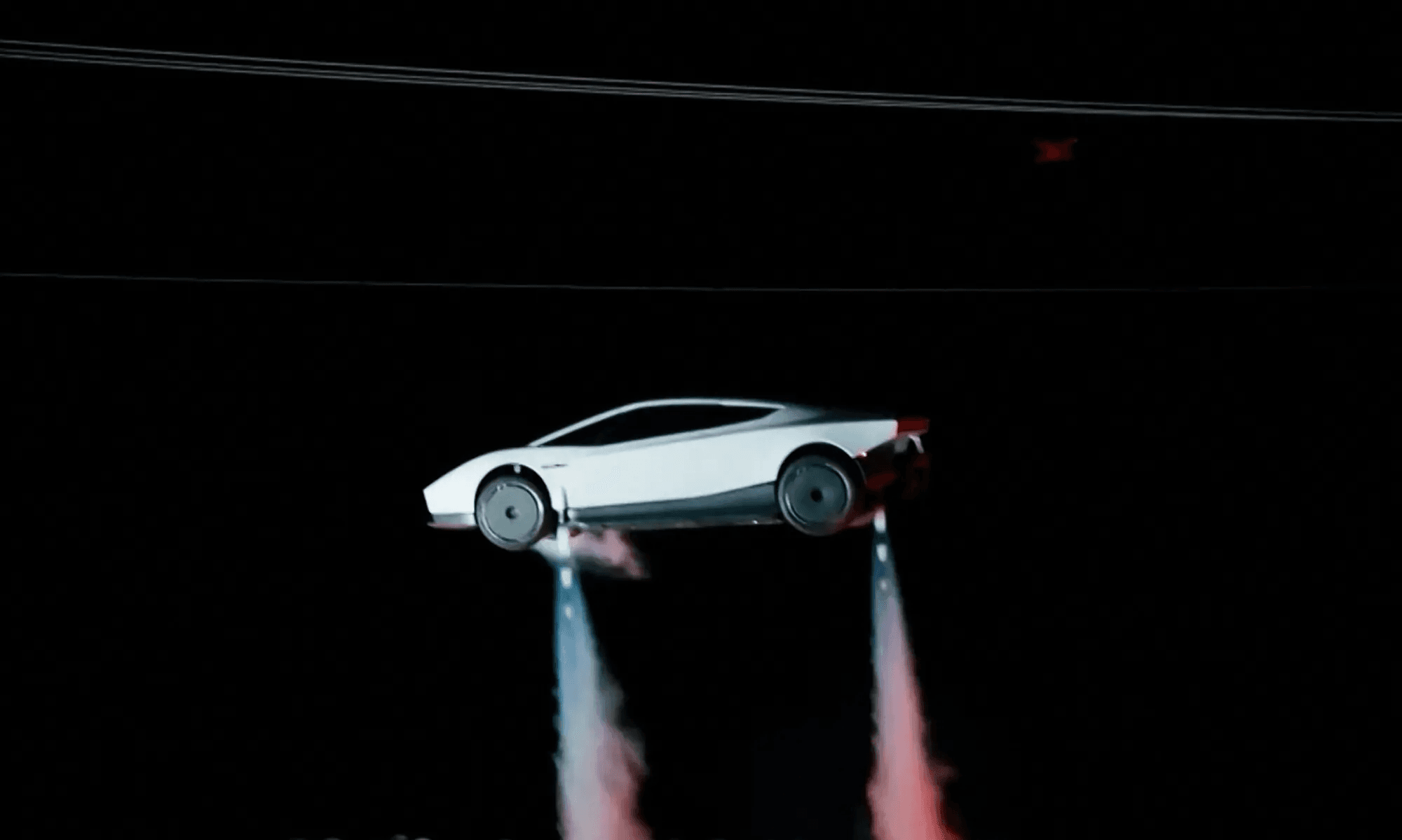
The Tesla flying Roadster is real — and it does kickflips. On October 15, 2026, Tesla unveiled its long-delayed second-generation Roadster at SpaceX's rocket test facility in McGregor, Texas, and then demonstrated it in a way no carmaker ever has: the car drove up a vertical curved ramp, hung upside down, launched into a mid-air rotation, and landed back on its wheels using SpaceX cold-gas thrusters. Elon Musk's caption on X said it all: "Turns out the future does have flying cars."
The spectacle closed with an even wilder stunt — the Roadster leaping clean over Tesla's own lineup (Model 3, Model Y, Cybertruck, Semi and Cybercab) while twisting in the air. But alongside the showmanship came a sobering detail: production is now targeted for 2028, roughly 11 years after the car was first revealed in 2017 with a promised 2020 delivery date. Here is everything the demo confirmed — the tech, the specs, the three trims, and what is still unknown.
Tesla Flying Roadster Demo: What Happened on October 15
The livestreamed event ran under 30 minutes, starting at 7:55 p.m. Central time (it had originally been scheduled for October 1 but was postponed over weather). The venue was deliberate: SpaceX's McGregor site near Waco, Texas, where rocket engines are test-fired — because, as the evening made clear, this Roadster is as much a SpaceX product as a Tesla one.
The centerpiece was the "kickflip": the prototype drove up a multi-storey curved ramp, continued along it upside down, flipped off the top, rotated in mid-air, and landed on its wheels. According to USA Today, the car was uncrewed and remote-operated for safety — the figure visible inside was not a human passenger. Before the stunt, Musk cautioned the crowd himself: "By the way, success is not guaranteed. I mean that. It'll probably work, but if it doesn't work, we're at a safe distance."
Musk framed the car as "the best of the last of the human-driven cars" — the one manually driven car Tesla plans to keep making as the rest of its lineup moves toward autonomy — and called the evening's work "the culmination of incredible work by Tesla and SpaceX engineers working closely together to make something that you haven't seen in any movie."
How the Flying Tech Actually Works
Two distinct systems combined to produce the footage, and understanding the difference matters.
The suction system: driving upside down
High-powered vacuum fans and a sealing system draw air from beneath the car, generating artificial downforce — Tesla rates it at up to 2g, versus roughly 1.26g from tyres alone. That suction is what held the prototype against the vertical, inverted ramp, even while stationary. The system switches between high-downforce and low-drag modes, and an active rear wing adjusts its pitch automatically to keep the car glued down through corners.
The cold-gas thrusters: the actual "flying"
The mid-air rotation and landing came from 10 SpaceX-derived cold-gas thruster nozzles fed by two carbon-fibre overwrapped pressure vessels holding about 600 litres of ultra-high-pressure air (roughly 250 kg). This is compressed air, not rocket combustion — and an on-board compressor re-pressurises the tanks, so the car refuels its own flight system. Reported output exceeds 80 kN of rear thrust. As AsumeTech's breakdown notes, the thrusters stabilised the car's rotation in the air after it left the ramp.
Tesla Roadster Specs: 0–60 in 0.81 Seconds
Tesla timed the headline number live on stage:
| Spec | Figure (Tesla claim) |
|---|---|
| 0–60 mph | 0.81 seconds (timed on stage) |
| Top speed | Over 230 mph |
| Range | 300+ miles |
| Downforce (suction) | Up to 2g |
| Thrusters | 10 cold-gas nozzles, 600L tanks |
| Controls | Steer-by-wire yoke, seats moulded into chassis |
Vehicle engineering chief Lars Moravy confirmed the sub-one-second sprint and 230+ mph top speed on stage. The design has been completely reworked since the svelte 2017 prototype: it is now hard-edged and angular in the Cybertruck idiom, with Tesla saying the styling draws on the SR-71 and F-35.
The Three Trims: Performance, Thrust and Rocket
Tesla plans three hardware configurations — and only the base one is a normal road car:
- Performance — the traditional road car. Uses the vacuum suction system for enhanced cornering and braking. Reservation deposit: $50,000.
- Thrust — adds rear-facing cold-gas thrusters for straight-line acceleration (the 0.81-second trim). Reservation deposit: $250,000.
- Rocket — the full perimeter thruster system from the Texas demo, in a single-seat layout (the passenger seat is removed to fit the pneumatic hardware). Invite-only — and Tesla states it is not approved for public roads, with Musk adding it "might not be legal in all jurisdictions."
Tesla Roadster Price and 2028 Production Date
No final vehicle price was announced at the event. When the Roadster was first shown in 2017, Tesla quoted a $200,000 base price — but that figure should not be treated as confirmed for the redesigned car. What is confirmed is the wait: production is targeted for 2028, which Musk acknowledged with unusual candour, admitting safety "had not been the top design priority" for the stunt machine on stage while insisting "this will be the actual car that's on the roads."
For context on how Tesla stages its big reveals, our coverage of the OPPO Find X10 global launch shows how differently a conventional 2026 flagship rollout looks.
Is the Flying Roadster Street Legal?
Short answer: the flying parts, no — not yet. The demonstration ran under controlled conditions at a private test facility, and Tesla's own materials say the Rocket configuration is not approved for public road use. Regulators have not weighed in on cold-gas thrusters or suction driving on public streets, and questions of safety certification, insurance and practicality are entirely unresolved. What the demo proves is narrower but still remarkable: the hardware works, the physics check out, and a car drove upside down and landed a kickflip in front of a live audience.
Conclusion
The Tesla flying Roadster demo was equal parts engineering milestone and marketing theatre — a genuine first (no production car has ever done a thruster-stabilised kickflip) wrapped in a very Tesla promise of "2028." Whether you read it as the future of driving or the most elaborate delay announcement in automotive history, October 15, 2026 is the night the flying car stopped being a joke. We will update this article as Tesla confirms pricing, homologation plans and a firmer production timeline.