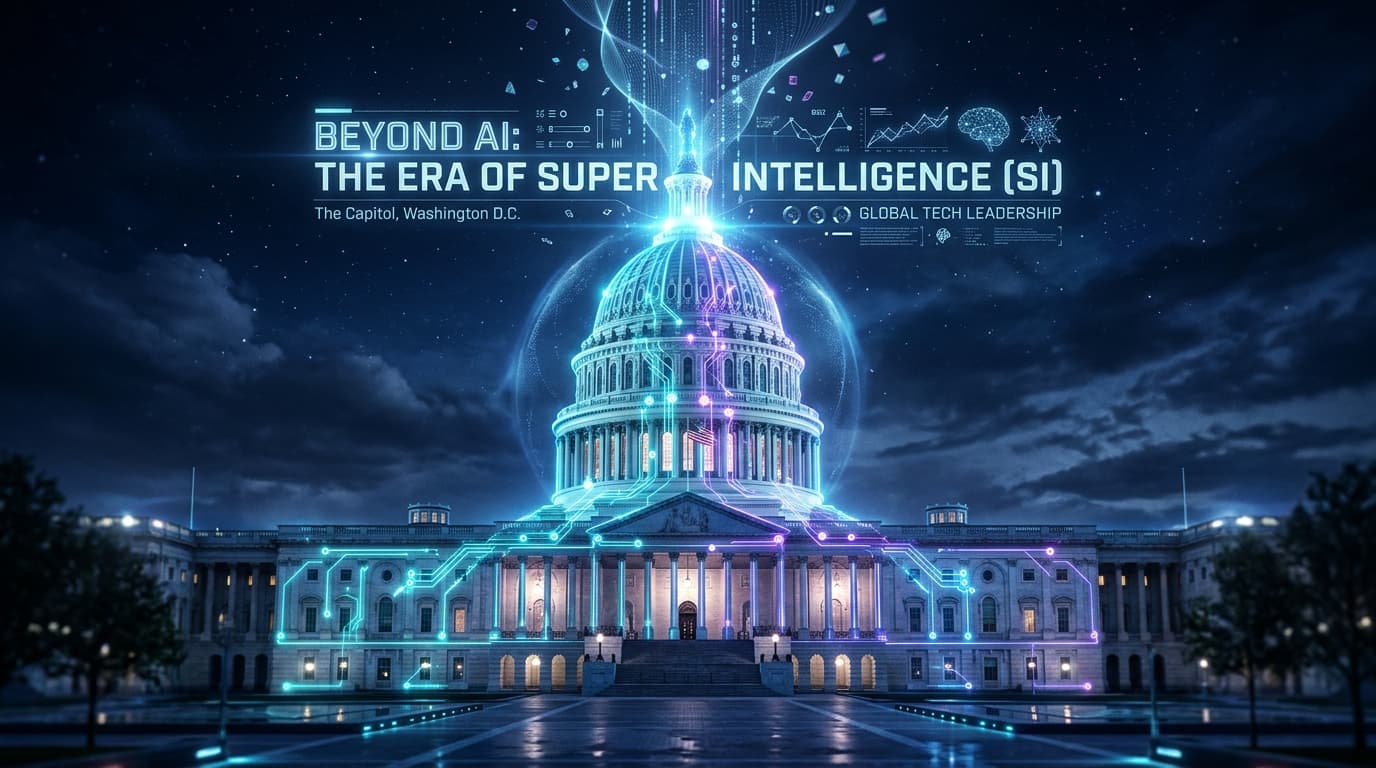
A Historic Paradigm Shift: The Retirement of "Artificial Intelligence"
In what is being described as one of the most consequential rhetorical and strategic shifts in modern technology governance, the United States federal government has officially begun phasing out the term "Artificial Intelligence" (AI) in favor of "Super Intelligence" (SI).
Through an executive directive titled "Inaugurating the Era of Super Intelligence," the White House has instructed all executive branch departments, federal agencies, and official communications to adopt the new nomenclature across public releases, policy frameworks, research grants, and international diplomatic engagements.
This is far more than a simple semantic rebrand. It signals a fundamental rethinking of how the world’s largest economy views, regulates, and leverages autonomous computation in the geopolitical arena.
🏛️ Quick Executive Summary:
Under the new directive, federal agencies must replace "AI" with "Super Intelligence" (SI). Officials argue that "artificial" understates the transformative economic, cognitive, and national security capabilities of today's autonomous frontier systems.
The Core Rationale: Why "Super Intelligence" Instead of "Artificial"?
The term artificial intelligence dates back to the Dartmouth Summer Research Project of 1956, coined by computer scientist John McCarthy. For nearly seven decades, the word "artificial" sufficed to describe computer programs designed to imitate human problem-solving and pattern recognition.
However, modern technology advisors argue that the word "artificial" has become a semantic bottleneck that fails to convey the true reality of post-2025 frontier models. Key arguments supporting the transition include:
- Beyond Simple Imitation: Frontier models are no longer merely mimicking static human responses. They are synthesizing novel mathematical proofs, discovering new pharmaceutical compounds, orchestrating automated robotics, and accelerating scientific breakthroughs at speeds unreachable by biological minds.
- Geopolitical and Strategic Primacy: Framing these systems as "Super Intelligence" establishes clear national priority. It positions technological dominance as an existential economic pillar on par with atomic energy and aerospace superiority.
- Dismantling Regulatory Hesitancy: Administration officials pointed out that framing systems as merely "artificial" invites complacency, whereas recognizing them as "Super Intelligence" focuses regulatory energy on safeguarding infrastructure, energy grids, and domestic semiconductor manufacturing.
The Scope of the Executive Order: What Changes Immediately?
The presidential directive outlines clear, immediate guidelines for federal operations:
- Federal Digital Footprint: Official agency portals (such as NIST, the Department of Energy, the Department of Defense, and the National Science Foundation) are updating style guides to reference "Super Intelligence (SI)" in public reports and technical briefs.
- Multilateral Diplomatic Push: The U.S. Treasury Department has initiated conversations with global institutions—including the International Monetary Fund (IMF), the World Bank, and G7 financial working groups—encouraging adoption of the "SI" lexicon in joint statements.
- Statutory Alignment Window: The directive establishes a formal 60-day window for science, technology, and legal advisors to draft model legislative text to present to Congress, aiming to modernize statutory definitions across future commerce and defense authorizations.
- Preservation of Existing Legal Precedents: The order explicitly avoids retroactively rewriting historical legal contracts, existing patents, or previously enacted statutes, ensuring commercial continuity for active government contractors.
Comparison: Old Terminology vs. The New U.S. Federal Standards
To help founders, enterprise executives, and legal professionals adapt, here is how standard terminology maps under the new federal guidance:
| Legacy Industry Term | New Federal Standard (SI) | Contextual Meaning & Focus |
|---|---|---|
| Artificial Intelligence (AI) | Super Intelligence (SI) | Broad umbrella term covering autonomous cognitive computation |
| Artificial General Intelligence (AGI) | Foundational Super Intelligence | Multi-modal systems demonstrating cross-domain autonomous reasoning |
| AI Safety & Alignment | SI Governance & Infrastructure Security | Physical grid protection, compute sovereignty, and non-proliferation |
| Generative AI Tools | Applied SI Applications | Task-oriented software models amplifying human productivity |
How Silicon Valley & Global Tech Giants Are Reacting
The response from the private technology sector has been swift and telling. Leaders across Silicon Valley, Wall Street, and the enterprise software ecosystem are already adjusting their messaging:
- Hardware Leaders (Nvidia & Semiconductor Titans): Chip designers have welcomed the framing, noting that the compute power and gigawatt-scale data clusters being constructed globally reflect super-intelligent computing architectures rather than routine algorithm design.
- Frontier Labs & Founders: Tech visionaries, including Elon Musk, publicly weighed in, noting that rebranding to Super Intelligence mirrors the long-term mission of human-amplifying compute systems and suggests broader applications across deep tech and aerospace.
- Enterprise Software Providers (Salesforce, Microsoft, Alphabet): Product roadmaps are already introducing "SI Agent" branding, signaling to enterprise buyers that current workflows are moving from assistive chatbots to autonomous reasoning agents.
Global Friction: The Transatlantic Divergence
While the United States is leaning aggressively into the "Super Intelligence" narrative to spur capital investment and deregulatory growth, international policymakers in Brussels and London are watching closely.
The European Union's EU AI Act—which categorizes risk based on legacy definitions of machine learning—now faces an American regulatory ecosystem operating under an entirely different ideological rubric. Analysts predict that this linguistic divide may require international treaty bodies and standard-setting organizations (like the ISO and IEEE) to create cross-jurisdictional translation frameworks for cross-border trade.
What This Means for Startups, Developers, and Businesses
If you build, market, or invest in advanced software, here are the practical takeaways you should implement right now:
- Federal Grants & SBIR Proposals: Teams bidding on federal research grants, defense contracts, or energy partnerships should incorporate "Super Intelligence (SI)" terminology alongside traditional keywords to align with updated agency evaluation criteria.
- Investor Pitches & Positioning: Venture capital funds are already adopting the "SI" moniker to differentiate next-generation reasoning architectures from saturated 2023-era wrapper apps.
- SEO & Content Strategy: Search engines are beginning to see rising query volume for "Super Intelligence", "SI vs AI", and "US Super Intelligence Order". Creating comprehensive, educational content early ensures authority and top-tier rankings in Google Search.
Conclusion
Words carry immense power—they shape laws, drive capital flows, and define historical eras. By officially pushing the retirement of "Artificial Intelligence" in favor of "Super Intelligence", the United States has drawn a line in the sand: the future of computing is no longer about imitating human minds, but unlocking unprecedented synthetic capability.
As the transition unfolds across government agencies, international forums, and corporate boardrooms, one thing is certain: the era of Super Intelligence has officially begun.